
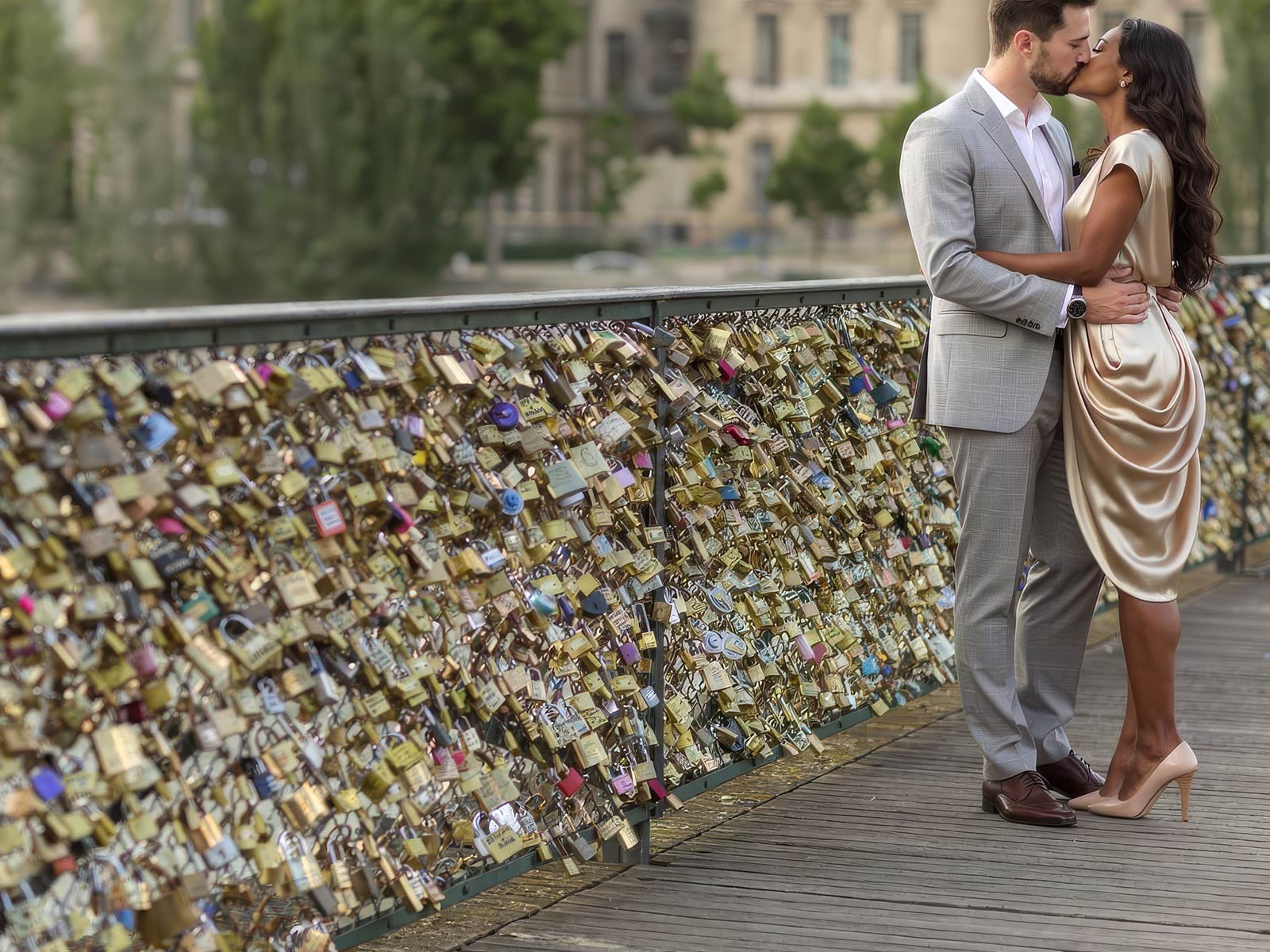
There are places in Paris that we visit because of their beauty, their history or their architecture, and then there are places that we experience differently because they seem to carry something more intimate within them, a collective memory made up of encounters, conversations, walks and personal stories that, over time, have given them an almost universal emotional significance.
The Pont des Arts undoubtedly belongs to this second category.
Located in the heart of Paris, between the Louvre and the Institut de France, the bridge offers one of the capital’s most iconic views over the Seine, its historic riverbanks and the architecture that has contributed for centuries to Paris’s reputation as one of the world’s most romantic cities.
Yet the Pont des Arts is fascinating for reasons that go far beyond its architecture or its extraordinary location.
Over the decades, it has become associated with something much more universal: the idea of love, connection and the possibility of two people, coming from different paths, finding a way to meet somewhere in between.
Two riverbanks.
Two journeys.
And between them, a bridge.
It is almost a perfect metaphor for what a meaningful romantic encounter can represent.
ELC
The Pont des Arts: A Bridge Steeped in History
The Pont des Arts occupies a distinctive place in the history of Paris, having originally been built in the early nineteenth century to connect the Louvre with the Institut de France and create a new pedestrian link between two important cultural landmarks of the capital.
The original bridge, constructed during the Napoleonic era, was designed as a pedestrian footbridge and already offered something rather special: the opportunity to cross the Seine while enjoying an uninterrupted view of Paris.
Over the decades, the bridge underwent several transformations and reconstructions, yet it retained the particular character that continues to distinguish it today.
Even its name carries a cultural dimension, referring to the former name given to the Louvre, once known as the Palais des Arts.
To cross the Pont des Arts is therefore to cross a small part of Parisian cultural history, between the Louvre, the Institut de France, the Seine and some of the capital’s most historic neighbourhoods.
It is difficult to imagine a setting that feels more unmistakably Parisian.
Why Did the Pont des Arts Become a Symbol of Love?
The romantic reputation of the Pont des Arts developed gradually, through generations of couples who came there to walk together, meet, exchange a few words, take photographs or simply admire Paris side by side.
Then came the famous tradition of love locks.
Couples from all over the world began writing their names, initials or significant dates on padlocks before attaching them to the bridge and throwing the keys into the Seine.
The gesture was simple, almost innocent, but its symbolism was powerful because it represented a desire to make love permanent, to leave a trace and to transform a private moment into a memory connected to one of the most iconic places in Paris.
The locks were eventually removed in order to protect the structure of the bridge, but their disappearance did not erase the romantic identity of the Pont des Arts.
Because, in reality, it was never the locks themselves that made this place romantic.
It was what couples experienced there, what they imagined there and what they chose to associate with that particular view of Paris.
Two Riverbanks, One Bridge: A Beautiful Metaphor for Love
This is perhaps where the Pont des Arts becomes particularly meaningful when viewed through the lens of romantic relationships.
A bridge exists because there are two riverbanks, two spaces that are different from one another and may be separated by a significant distance, yet can still be connected by a common path.
Romantic relationships often work in much the same way.
Two people enter a relationship with their own history, experiences, habits, values, achievements, vulnerabilities and sometimes their own emotional wounds, without necessarily having lived through the same experiences or built their lives in the same way.
They do not come from the same place.
They do not have to be identical.
They may even have very different personalities or backgrounds.
And yet, something can bring them together.
A meaningful romantic relationship can be seen as the gradual construction of a bridge between two individual stories.
What matters is therefore not that the two riverbanks are identical, but that a genuine path between them can exist.
Love Does Not Necessarily Mean Finding Your Exact Double
We sometimes imagine that the person who is right for us should share exactly the same tastes, passions, habits or background.
This search for similarity can feel reassuring, but it is not always enough to create a lasting relationship.
Two people may have very different worlds and still share the values that truly matter, while two people who appear to have almost everything in common may eventually discover that they have very different expectations of a relationship or completely different visions of what life together should look like.
True compatibility is often found in the subtle balance between what brings two people together and what makes them different.
Someone may introduce us to an unfamiliar world, offer a different perspective or have a personality very different from our own, while still sharing the fundamental values that make a lasting relationship possible.
A beautiful relationship does not erase differences; it learns how to connect them.
The Pont des Arts and Paris's Romantic Imagination
Paris has long been associated with love in the collective imagination, through the Seine, its cafés, gardens, historic streets, monuments and the particular light that transforms the city throughout the day.
Some places, however, concentrate this romantic symbolism more intensely than others, and the Pont des Arts is undoubtedly one of them.
It offers something remarkably simple: a place where two people can walk slowly, look at the Seine, observe the city and take the time to simply be present with one another.
At a time when romantic encounters are often fast, digital and sometimes reduced to photographs and a few lines of text on a screen, this simplicity can almost feel like a form of luxury.
Taking the time to look at someone, listen to their voice, discover their sense of humour, understand the way they think and simply walk at their pace are all very simple experiences, yet they remain at the heart of genuine human connection.
Is the Pont des Arts a Good Place for a First Date?
There is, of course, no place capable of creating a love story by itself, but certain locations have the ability to create an atmosphere in which two people can discover one another more naturally.
The Pont des Arts is one of those places.
A walk across the bridge allows two people to step away from the highly structured format of a traditional dinner and enter an environment in which conversation can develop more naturally.
You walk, you look at Paris, you exchange impressions, you stop for a moment to admire the Seine and, gradually, you discover the other person’s personality without feeling that every second of the encounter needs to be filled with conversation.
If there is a genuine connection, the walk can naturally continue towards the Seine, the Louvre or Saint-Germain-des-Prés, perhaps followed by a drink or dinner.
The location then becomes more than a backdrop.
It becomes part of the memory of a first encounter.
When Is the Best Time to Visit the Pont des Arts Together?
The Pont des Arts has a different atmosphere depending on the time of day, but late afternoon is perhaps one of the most beautiful moments for a romantic walk.
As the light becomes softer and the sun gradually begins to descend, the façades of Paris take on warmer tones and the city seems to slow down, revealing a different side of itself.
Sunset adds another layer of romance to the experience, while the arrival of night gradually transforms Paris into a landscape of lights.
For a first date, early evening can be particularly appealing because the meeting can begin with a simple walk before naturally continuing, if both people wish, over a drink or dinner.
A first date does not necessarily need to be planned down to the smallest detail.
Leaving some room for spontaneity can allow the encounter to find its own rhythm.
And What Comes After the Pont des Arts?
The central location of the Pont des Arts makes it particularly easy to continue a romantic encounter.
After crossing the bridge, you can walk along the Seine, continue towards the Louvre, head towards Saint-Germain-des-Prés or simply stop somewhere elegant for a drink.
This possibility of allowing the evening to evolve naturally is one of the great advantages of a first date in this part of Paris because it avoids creating a rigid timetable.
When two people are genuinely enjoying one another’s company and the conversation is flowing, they rarely need to think about the time.
The evening simply continues.
And when the connection is not there, the walk can also come to a graceful conclusion without either person feeling trapped in a formal dinner lasting several hours.
Why Do Certain Places Remain Associated With Love?
A place becomes romantic when stories gradually become attached to it.
Dates, reunions, declarations, first kisses and unforgettable conversations become part of the emotional memory of a location, and over generations these individual experiences can eventually become part of the identity of the place itself.
The Pont des Arts belongs to this category.
Even after the love locks disappeared, couples continued to walk across the bridge, take photographs and share moments there because the symbolism of the location had become more powerful than the object that originally made it famous.
Perhaps the true message of the Pont des Arts is not that love must necessarily last forever.
Perhaps it is something much simpler and much more human:
“We are here, together, today.”
Does Romance Still Matter in the Age of Dating Apps?
Dating apps have profoundly changed the way people meet and have made it possible for many individuals to discover people they would probably never have encountered otherwise.
Yet this convenience has also changed our relationship with choice, time and sometimes with romance itself, because the possibility of constantly discovering new profiles can create the impression that we should always be looking for someone different, more attractive or closer to the ideal image we have created in our minds.
In this predominantly digital environment, a place such as the Pont des Arts represents almost the opposite of that logic.
You have to be present.
You have to look.
You have to listen.
You have to walk.
And above all, you have to meet a real person rather than a profile.
Perhaps that is precisely why romantic places in Paris continue to fascinate us.
They remind us that romantic connection can never be completely reduced to a photograph, a description or an algorithm.
The Real Connection Begins Long Before the First Date
At ELC International, we believe that the quality of a romantic encounter does not depend solely on the place where two people eventually meet.
A beautiful location can create an atmosphere, encourage conversation and make a moment more enjoyable, but it cannot create compatibility between two people.
That requires a much deeper understanding of their personalities, values, histories, expectations, lifestyles and visions of a relationship.
This is why our approach to high-end matchmaking is not about presenting as many profiles as possible.
It is about looking for the encounter that truly makes sense, the kind of meeting in which two people can recognise something meaningful in one another, discover each other naturally and perhaps begin to build something that genuinely reflects who they are.
Just as a bridge does not erase the distance between two riverbanks, a meaningful relationship does not require two people to become the same.
It simply gives them a way to cross the distance between their individual worlds.
A Bridge Connects Two Riverbanks. A Meaningful Encounter Connects Two Stories.
Perhaps this is ultimately what makes the Pont des Arts such a powerful symbol.
It does not promise a love story, guarantee happiness or create the magic of a romantic encounter.
But it offers a beautiful image of what a relationship can represent: two people arriving from two different paths who decide, for a moment or perhaps for a lifetime, to meet somewhere in between.
And in a city like Paris, where almost every street, café and riverbank seems to have witnessed a love story, the Pont des Arts remains one of the most evocative places to imagine the beginning of a new one.
What If Your Next Story Began in Paris?
At ELC International Paris, we accompany women and men who want to bring greater meaning to their search for love and who no longer wish to leave their romantic life entirely to dating apps, chance encounters or endless scrolling through profiles.
Our approach is based on confidentiality, attentive listening, personalised selection and a deep understanding of each individual before any introduction is made, with the aim of finding not simply someone who matches a list of criteria, but someone with whom genuine compatibility has the opportunity to emerge.
Because an exceptional encounter is not simply about finding someone you are attracted to.
It is about meeting someone with whom you can genuinely build a shared path.
Are you ready to meet someone who could truly make sense in your life?
Partagez
Love Coach